
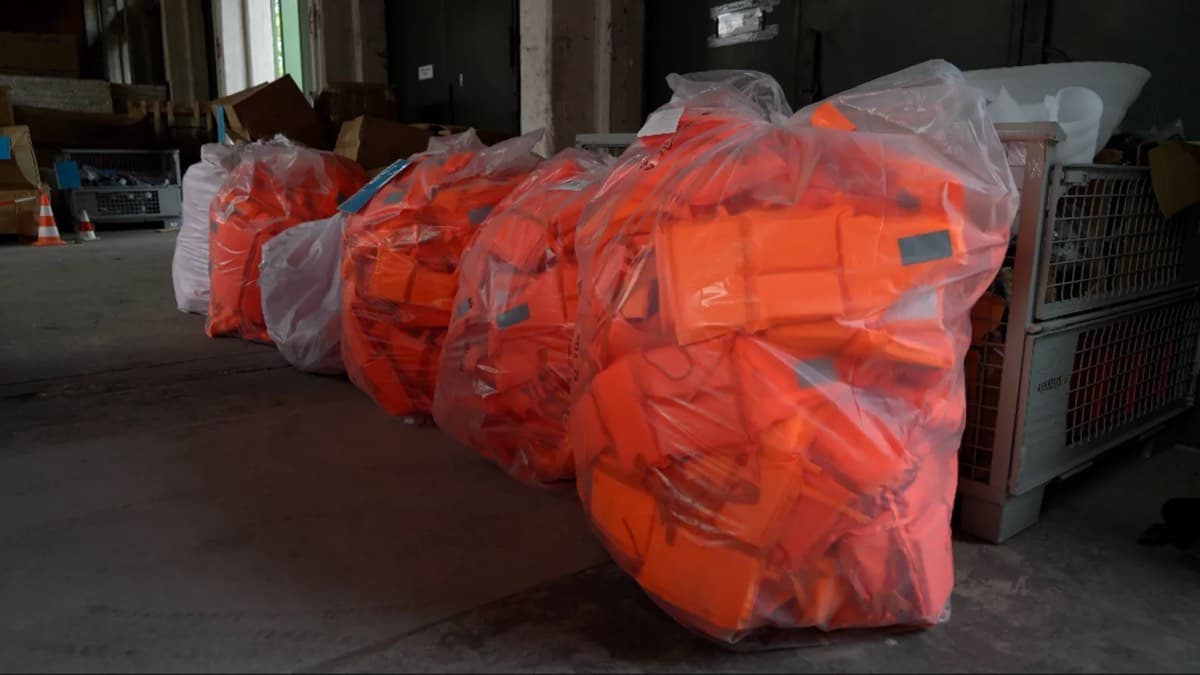
The dangerous small boats and life jackets that carry migrants across the Channel are passing through an unlikely waypoint on their journey to the French coast. Investigators say Germany has become a key storage and assembly point in the supply chain that keeps the crossings running, a hidden link between factories in Asia and the beaches of northern France.
According to a British National Crime Agency assessment, the pattern is now well established. The equipment is manufactured in China, brought together in Turkey, stored in Germany and then moved on to northern France, where it is loaded with people and pushed out to sea. Germany's location and logistics make it a convenient middle stage in a trade built on human desperation.
The death trap life jackets
The life jackets at the centre of the story are not the safety equipment the name suggests. Many are cheap, fake or improvised, offering little real buoyancy, and some are little more than padding that would do nothing to keep a person afloat in cold, rough water. Investigators have described them as death traps, sold to people who believe they are buying protection for one of the most dangerous journeys in Europe.
Alongside the jackets come the boats themselves, thin inflatable dinghies never meant to carry the numbers crammed onto them, together with engines, pumps, fuel cans and even tyre inner tubes pressed into service as makeshift floats. Assembled into a single package, the kit can sell for well over 10,000 euros on the black market, a steep price for equipment that so often fails.
What has been seized
The scale of the trade has been laid bare by recent seizures. In an operation in the German state of North Rhine-Westphalia, authorities recovered more than 30 boats, over 20 engines, some 360 pumps and more than 9,000 life jackets. By the National Crime Agency's reckoning, the boats alone could have carried more than 2,000 people across the Channel.
Those numbers hint at how industrial the smuggling has become. This is not a matter of a few opportunists but a logistics network moving equipment in bulk, and the stockpiles found in Germany suggest the country has been serving as a warehouse for a trade that ends on the water between France and England.
The people behind the trade
Investigators have put names to some of the supply. A Turkish national identified as Adem Savas is said to have supplied thousands of boats and engines between 2019 and 2024, including equipment used in roughly half of all Channel crossings in 2023. That single figure captures how much of the trade can run through a small number of well-connected suppliers.
Enforcement has been stepping up in response. A string of raids in Germany has led to arrests, part of a wider international effort involving European agencies to disrupt the networks that feed the crossings. Breaking the supply chain, officials argue, may do more to slow the boats than trying to stop each departure on the French shore.
A shared problem for Berlin and London
The findings put Germany squarely inside a crisis often framed as a purely British or French one. As the storage link in the chain, the country has become central to how the crossings are supplied, and that has drawn Berlin into closer cooperation with London on tackling the trade. Germany has moved to tighten its people-smuggling laws as part of an agreement with the United Kingdom, closing gaps that had allowed equipment to be stored and traded with little legal risk.
The deeper challenge is that the networks adapt quickly, shifting routes and suppliers whenever one link is cut. Germany's role as a hub is a reminder that the Channel crossings are the visible end of a long, cross-border business, and that slowing them will depend as much on warehouses and supply routes far from the water as on what happens at the beach itself.