
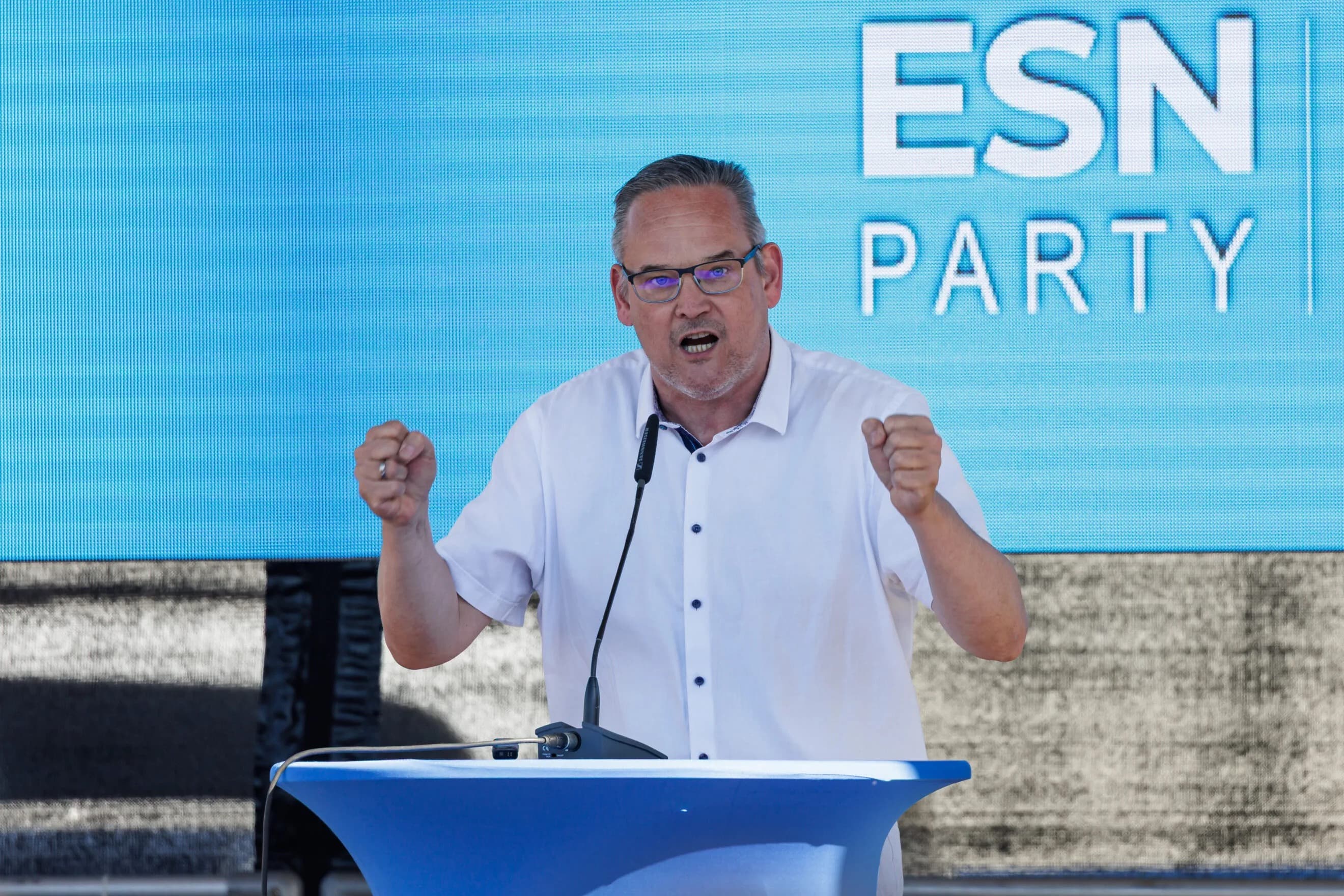
A senior lawmaker from Germany's far right Alternative for Germany is facing questions over a photograph from 2020 that two witnesses say captured him performing a Nazi salute, an accusation he firmly rejects.
The image, published this week by Politico's Inside AfD podcast, shows the federal politician Martin Reichardt with one arm raised while another man kneels on one knee in front of him. According to Politico, two people who were present say the gesture was meant as a Hitler salute.
Two very different accounts
The witnesses told the outlet that the kneeling man, Markus Motschmann, was handing Reichardt an application to join the AfD and addressed him as "Mein Führer", the German phrase once used for Adolf Hitler. Motschmann has denied saying those words.
Reichardt offered a starkly different reading of the scene. He told Politico that the raised arm "wasn't a Hitler salute" at all, describing the moment instead as part of "a humorous knighting ceremony" among party colleagues. The photograph shows his left arm raised, not the right arm traditionally associated with the Nazi gesture.
His regional party also pushed back. The AfD's branch in Saxony-Anhalt defended Reichardt in a post on X, dismissing the reporting as "a cheap attempt to spin a scandal out of nothing".
Why it carries legal weight
In Germany the stakes of such an allegation are unusually high. Displaying Nazi symbols or performing the Hitler salute in public is a criminal offence, a legacy of laws written to keep the imagery of the Third Reich out of public life. An accusation of this kind is therefore not only a political embarrassment but a potential legal matter.
Reichardt is not the only AfD figure caught up in such a case. Another of the party's lawmakers, Matthias Moosdorf, is facing a criminal charge over claims that he greeted a fellow member with a Nazi salute inside the Reichstag, the seat of the German parliament. Moosdorf denies the allegation.
A party under the microscope
The episode lands at a delicate moment for the AfD, which has been riding high in the polls while fending off persistent claims that parts of it flirt with the imagery and language of the Nazi era. Each new allegation feeds a wider argument among critics that the party has never fully drawn a line between provocation and extremism.
For now the facts of the 2020 gathering remain contested, a single photograph read two ways by people who were in the room. What is not in doubt is the sensitivity of the charge in a country where the salute in question is treated not as a tasteless joke but as a crime.