
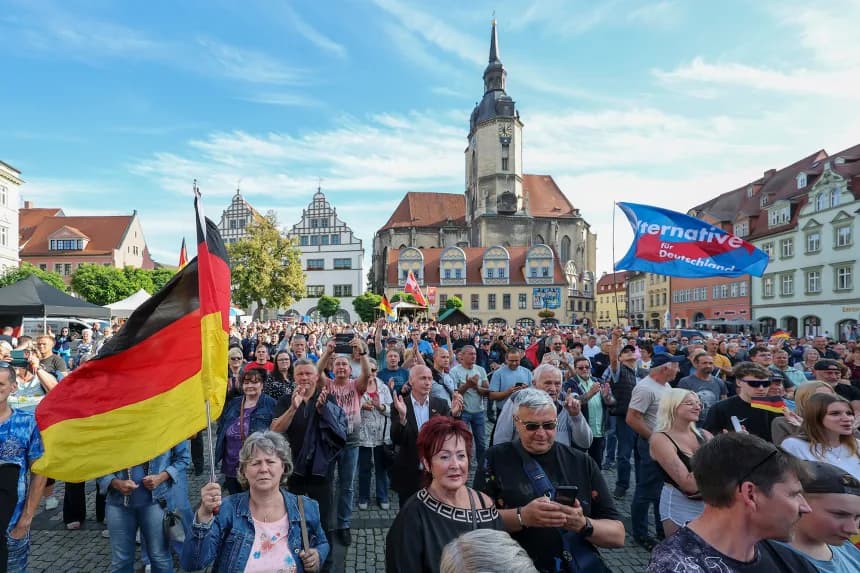
The Alternative for Germany heads into Sunday's Saxony-Anhalt election with a commanding lead of around 42 percent, a margin that could hand the party an outright majority and make it the first far right movement to lead a German state government since the Second World War.
The electoral math behind that lead is almost as striking as the number itself. Germany's mainstream parties collectively poll around 54 percent in the state, but their support is split across enough parties that some are projected to fall below the 5 percent threshold required to win any seats at all. That fragmentation means the AfD could take control of the state government without needing anywhere close to a majority of the actual electorate.
A Careful Balancing Act on Foreign Policy
As the party edges toward real governing power, its posture toward Washington and Moscow has come under closer scrutiny. Lead candidate Ulrich Siegmund has framed his position as one of pragmatic balance rather than allegiance to either power, saying the AfD wants a good relationship with both Russia and the United States, while making clear that neither relationship takes precedence over what he calls the German interest.
That framing lets Siegmund avoid being pinned down as either pro Kremlin or simply pro Trump, a useful position for a candidate trying to consolidate as broad a coalition of far right and disaffected voters as possible heading into election day.
A Party Still Divided Nationally
Away from Siegmund's carefully calibrated messaging, the AfD's national leadership has shown far less consistency on Donald Trump specifically. Party figures have alternated between praising his domestic agenda on immigration, culture war issues and nationalism, and criticizing his willingness to intervene in the affairs of other countries, a contradiction that has never been fully resolved within the party's ranks.
That inconsistency reflects a broader tension inside European far right movements more generally: an ideological affinity for Trump style nationalism sitting uneasily alongside resentment of American influence over European politics and, in the AfD's case, competing sympathies toward Russia.
Why It Matters
As long as the AfD remained shut out of governing power, its foreign policy ambiguity cost it little, since campaign rhetoric rarely faces the same scrutiny as actual governance. A win in Saxony-Anhalt would change that calculus, giving the party's stated commitment to putting German interests first over relationships with Washington or Moscow its first real test in office.
How Siegmund navigates that balancing act in practice, rather than in campaign soundbites, is likely to be watched closely both by Berlin and by capitals well beyond Germany's borders, given the stakes of a far right party governing a German state for the first time in eight decades.