
Europe’s most ambitious health-data reform is moving from legislation into execution, and the message to health systems, ministries, hospitals, EHR vendors, interoperability platforms, cloud providers, data companies, and AI suppliers is blunt: the European Health Data Space will not reward those who are merely connected. It will expose those who are not truly interoperable.
The European Health Data Space Regulation entered into force in March 2025 and establishes a common EU framework for the use and exchange of electronic health data, including patient access and control, cross-border care, secondary use for research and policy, and a more harmonised market for EHR systems. The European Commission’s implementation timeline puts key implementing acts in 2027, EU-wide exchange of patient summaries and ePrescriptions/eDispensations by 2029, and medical images, laboratory results, and hospital discharge reports by 2031.
That timeline looks generous. It is not.
Across Europe, the gap is no longer between countries that have digital health strategies and those that do not. It is between countries, providers, and vendors that can produce structured, coded, consent-aware, auditable, reusable health data and those still relying on portals, PDFs, custom interfaces, and post-procurement optimism.
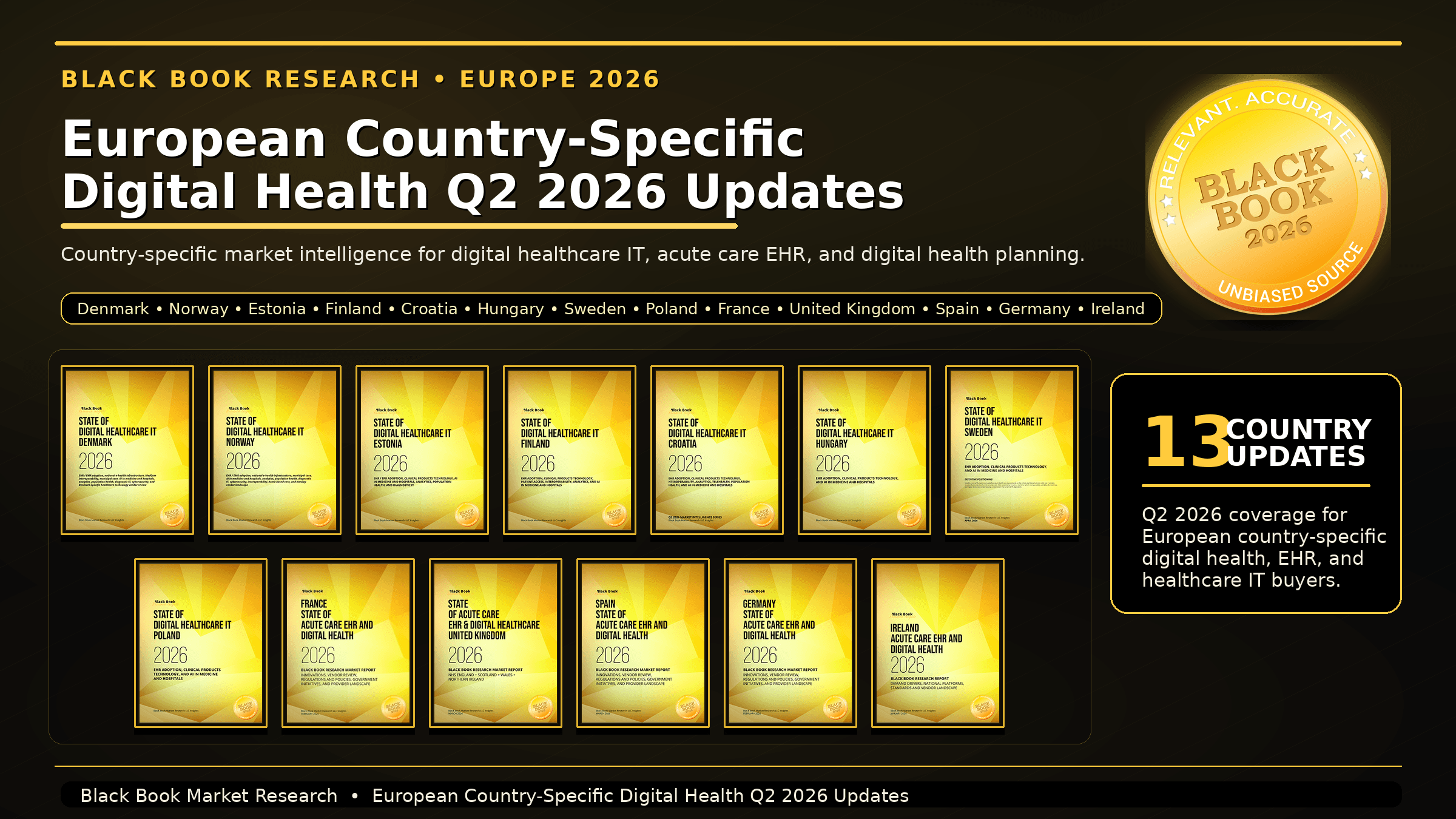
Recent European healthcare IT studies show the scale of the problem. In a June 2026 Black Book Market Research survey of 1,756 European healthcare IT, clinical, informatics, compliance, and executive respondents, 72% said their EHR/EPR could connect to external systems in at least one major workflow, but only 24% described their platform as capable of structured, reusable, workflow-embedded interoperability. Just 19% said their vendor had provided a credible product-specific EHDS readiness plan, and only 13% rated their primary vendor as well prepared for true interoperability and EHDS-aligned exchange.
That is the fault line now opening beneath European healthcare.
EHDS is not simply asking whether data can move. It is asking whether health data can be trusted when it arrives, understood by clinicians, governed by patient rights, reused lawfully for research, protected in secure processing environments, and made available across borders without forcing every hospital to pay again for bespoke integration.
The regulation gives patients stronger rights over electronic health data, including free access to priority categories of data, portability, the ability to restrict access, transparency over who accessed their records, and opt-out rights for secondary use. It also introduces secure secondary-use access through health data access bodies, data permits, secure processing environments, and prohibitions on re-identification and misuse.
But rights on paper require systems in production.
The new market reality is already visible. Finland with Tietoevry Lifecare, Austria with InterSystems HealthShare, Estonia with Nortal HIS/EHIS, Germany with CompuGroup Medical, France with Softway Medical, Slovenia and the Netherlands with Better openEHR, and other national and regional leaders are being scrutinised not for brand visibility, but for practical evidence of structured exchange, workflow usability, auditability, portability, and EHDS-readiness.
A separate May 2026 Black Book study of 662 healthcare IT leaders across eight major European EMR markets found that Europe’s EHR market has moved beyond basic digitisation. Providers are no longer judging vendors by go-live, documentation, or installed footprint. They are judging whether systems produce reliable clinical data that can support care coordination, analytics, population health, regulated secondary use, clinical research, AI readiness, and measurable improvement in outcomes.
Respondent-rated country leaders included Tietoevry Lifecare in Finland, System C CareFlow in the UK, Systematic Columna CIS in Denmark, ChipSoft HiX in the Netherlands, Cambio COSMIC in Sweden, InterSystems TrakCare/HealthShare in France, CompuGroup Medical in Germany, and CGM SELENE in Spain.
This is where the political story becomes commercial.
For vendors, EHDS will become a contract test. Buyers will ask: What exactly will be delivered? When? At what price? Under what certification assumptions? With what audit logs, consent functionality, patient access controls, terminology governance, data export capabilities, secure-processing support, and liability allocation?
For hospitals, EHDS will become a budget test. Compliance cannot be delivered by strategy documents. It requires line-item funding for data quality, consent architecture, vendor upgrades, integration, cybersecurity, auditability, patient access, and secondary-use workflows.
For countries, EHDS will become an execution test. National digital maturity will no longer be measured by the existence of portals or ePrescription programmes alone. It will be measured by whether data flows safely, semantically, and usefully across care settings, borders, research systems, and regulators.
For AI, EHDS will become the gatekeeper. Europe cannot build sovereign, clinically credible health AI on fragmented, uncoded, ungoverned, or legally uncertain datasets. The promise of European health AI depends on the boring but decisive infrastructure of data quality, provenance, identity, consent, access controls, and reuse governance.
And for patients, EHDS will become the moment of truth. The European promise is that a citizen’s health data should not become trapped behind a hospital wall, vendor contract, national border, or obsolete format. The challenge is whether Europe can make that promise operational before public trust is lost.
The European Commission says EHDS is expected to generate €11 billion in savings over the next decade, support healthcare efficiency, expand the digital health sector, strengthen research and policymaking, and improve outcomes for European citizens.
That prize is real. So is the risk.
Europe has legislated the world’s most consequential health-data framework. Now Europe must decide whether EHDS becomes a functioning public-interest infrastructure or another procurement cycle in which vendors sell interoperability, hospitals fund workarounds, and patients wait for the system to catch up.
The next phase of EHDS will not be won by the loudest compliance claims. It will be won by countries and vendors that can prove, in production, that health data is portable, usable, secure, auditable, and ready for care, research, and responsible innovation.
Download Black Book Market Research reports, gratis to European hospital leaders, government agencies and other healthcare providers at https://www.blackbookmarketresearch.com or contact research@blackbookmarketresearch.com