
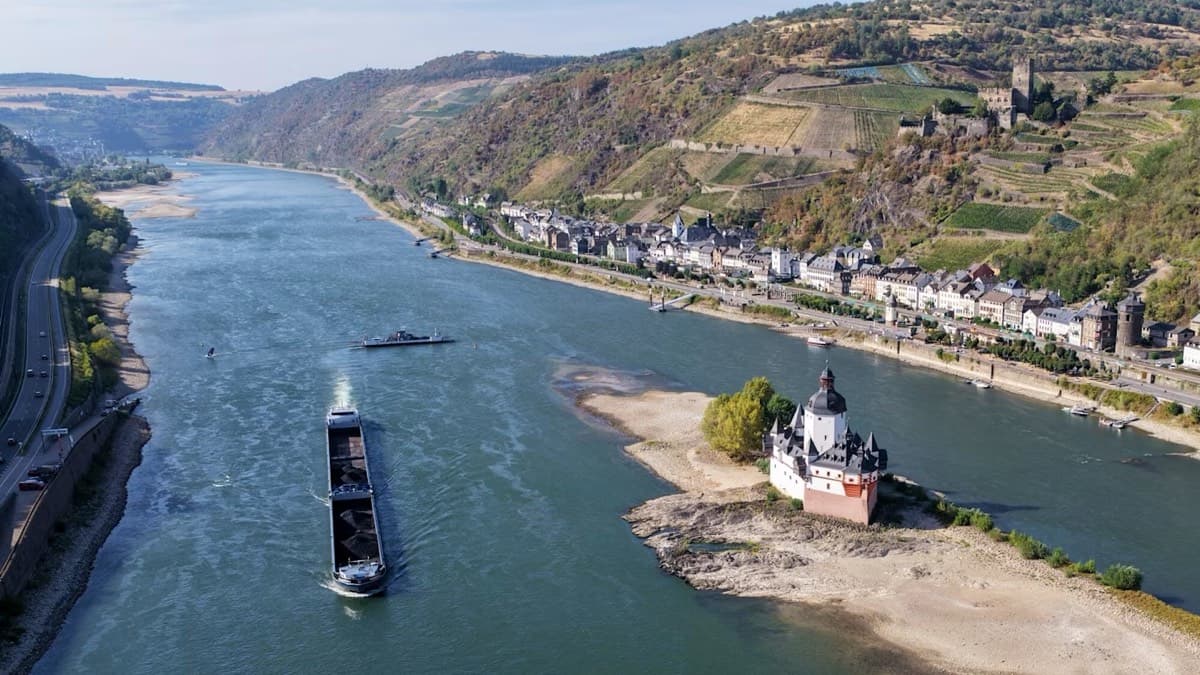
One of the arteries of the German economy is running dry. The Rhine, the river that carries fuel, coal, grain and chemicals through the industrial heart of the country, has fallen to its lowest level since measurements began in 1880, and the effects are already rippling out from the water to the factories that depend on it.
The trouble is concentrated at Kaub, a narrow stretch that is the river's shallowest choke point and the gauge the shipping industry watches most closely. Readings there dropped to only around 16 to 17 centimetres in mid-August, with forecasts pointing to single-digit figures within days. At those depths a river built for heavy cargo becomes barely usable.
Barges stuck, cargo at risk
For the vessels that ply the Rhine, the shrinking channel is close to a wall. The shipping broker Riverlake warned that Kaub has become effectively impassable, leaving barges positioned on the Upper Rhine unable to make their way back to the great northern ports of Antwerp, Rotterdam and Amsterdam. When the boats cannot move, neither can the goods they carry.
Those goods are the raw material of daily economic life. The Rhine hauls diesel, heating oil and coal alongside grains and even cocoa, and a blockage at Kaub threatens the steady flow of all of them. Even where barges can still sail, they must travel far lighter than usual to avoid running aground, which means more trips, less cargo and higher costs for everything moving on the water.
Industry counts the cost
The pain is landing squarely on German manufacturers. The polymer maker Covestro said the low water is disrupting the supply of raw materials and production at individual sites, and it put the alternative in stark terms, noting that it takes around 60 trucks to replace a single barge carrying 1,500 tonnes. Shifting freight from river to road is possible, but it is slow, expensive and nowhere near able to fill the gap.
Utilities are feeling it too. The energy group EnBW estimated that the disruption on the Rhine would knock a low double-digit million euro sum off its earnings, a reminder that a shallow river quickly becomes a line on a corporate balance sheet. For an economy already under strain, another self-inflicted bottleneck is the last thing it needs.
A drought with deep roots
The low water is the visible symptom of a wider dryness. The German Weather Service reported that soil moisture across southern and central Germany had fallen to levels comparable with the severe drought years of 2018 and 2022, the last times the Rhine crisis bit hard. When the ground itself is parched, there is little to feed the rivers that run through it.
Relief is not close at hand. Forecasters say it would take weeks of steady rain to lift the Rhine back toward normal, which means the disruption could stretch into October. Until then, shippers will nurse half-empty barges through the shallows and factories will pay to move by road what the river can no longer carry.
A recurring warning
This is not the first time the Rhine has run low, and that is part of what makes it so unsettling. Each drought episode, from 2018 to 2022 and now 2026, exposes how much German industry still leans on a waterway that a hot, dry summer can throttle. The events arrive more often and hit harder as the climate shifts, turning what was once a rare disruption into a familiar hazard.
The deeper question is how long the country can keep absorbing these shocks without rethinking how its goods move. For now the priority is getting through the season, but every record low renews the argument that Germany cannot leave so much of its supply chain at the mercy of the weather. The river will rise again, yet the vulnerability it exposes is not going anywhere.