
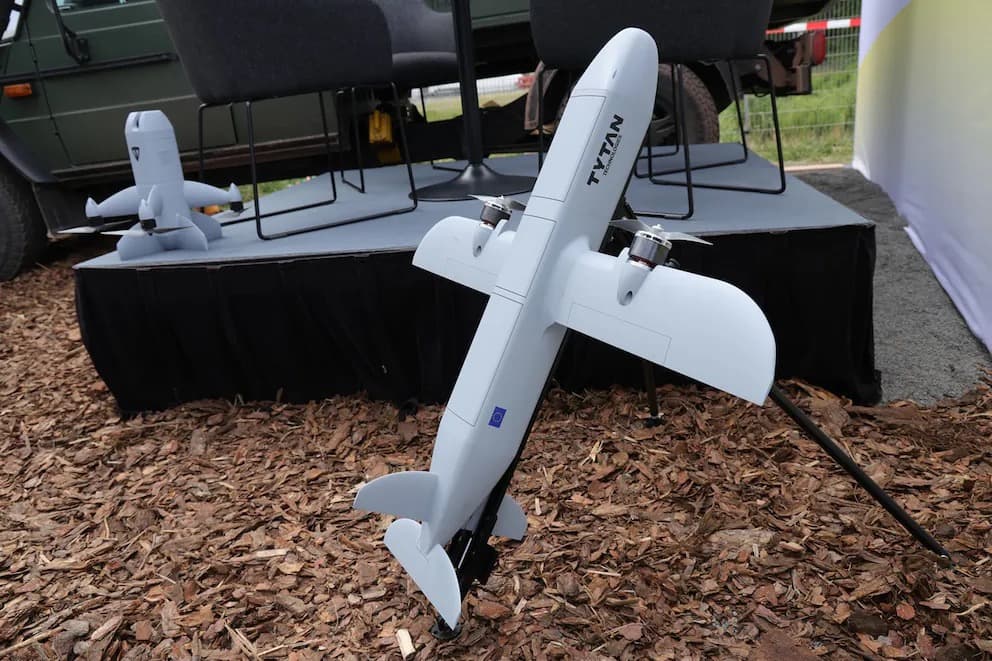
A German startup that builds drones designed to hunt other drones is scaling up fast, betting that the cheap, fast interceptors it has tested over Ukraine are about to be in heavy demand across Europe.
Tytan Technologies plans to open a new factory in Germany in August, a plant the company says will be able to turn out around 3,000 interceptor drones a month, or some 36,000 a year. It is a striking jump in ambition for a firm that only recently moved from prototypes to serial production.
Battle tested over Ukraine
What sets Tytan apart is that its hardware has already been used in a real war. Its interceptors have been deployed in Ukraine, where they have been credited with knocking Russian drones out of the sky, the kind of practical proof that no test range can fully replicate. Germany has also ordered more than 1,000 of the company's METIS interceptors for Ukraine, turning a young supplier into a fixture of the war effort.
The appeal is in the design. Tytan's interceptor can fly at more than 250 kilometres per hour and reach beyond 15 kilometres, while weighing just 5 kilograms and carrying a payload of up to 1 kilogram. It is built to chase down the slow, cheap attack drones that have come to define this war, and to do so without firing an expensive missile at a target worth a fraction of the price.
Money and momentum
Investors have taken notice. Tytan raised 30 million euros in a funding round earlier this year led by Armira and the NATO Innovation Fund, lifting its total backing to around 46 million euros. That money is going into expanding production in both Germany and Ukraine, a twin track approach that keeps the company close to its main customer and its main proving ground at once.
The Bavarian site marks the company's shift from a development shop into a manufacturer, the moment a promising idea has to prove it can be built at scale and on time. For a sector where many startups stall at exactly this step, hitting the numbers Tytan is promising would be a notable achievement.
A wider race to defend the skies
Tytan is riding a broader scramble across Europe to counter the drone threat cheaply. Air defences built to stop jets and missiles are poorly suited to swatting swarms of low cost drones, and the cost of using them that way is unsustainable. Interceptors that cost a small fraction of a guided missile offer a way out of that trap, which is why a company like Tytan suddenly finds itself in demand.
The firm is already looking beyond its home market, with possible expansion into countries such as Hungary and Poland. If the new factory delivers, Tytan will have turned lessons learned in Ukraine into an industrial answer to one of the most pressing problems on the modern battlefield, how to stop a drone without going broke doing it.