
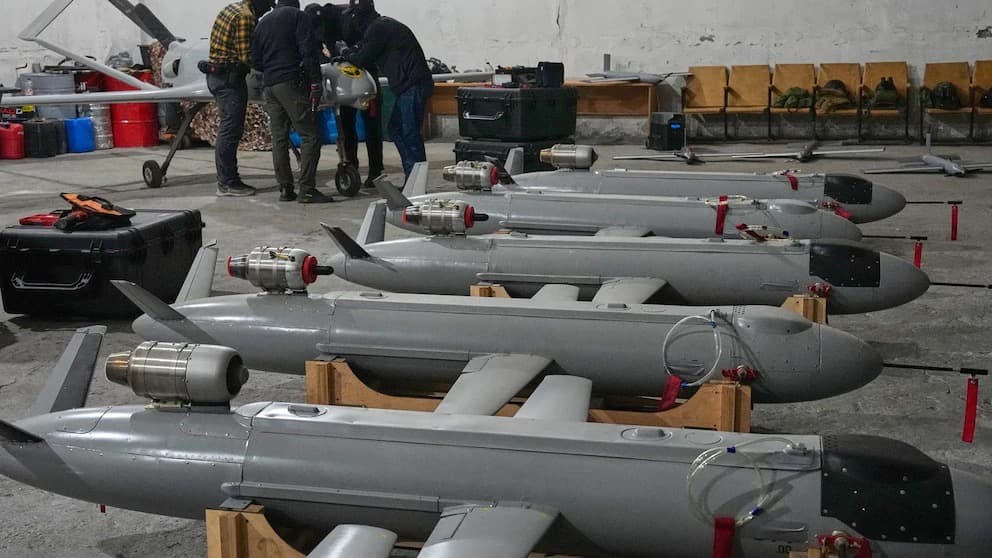
The war that Russia expected to fight on Ukrainian soil is increasingly being carried back across its own border, one drone at a time. Over the past year Ukraine has built a long-range strike campaign that now reaches deep into Russian territory, and it is starting to reshape the fight on the ground.
The weapons at the centre of this shift are cheap, patient, and made at home. Rows of Ukrainian built drones, some capable of flying more than a thousand miles, are turned out in workshops and sent to hit the targets that keep the Russian war machine running.
Striking the fuel that feeds the war
The favoured targets are oil refineries and fuel depots. On June 18 Ukraine launched what it called its largest drone offensive yet against Moscow, setting a refinery ablaze and sending black smoke over the capital as residents described an oily residue falling from the sky. Similar strikes have reached facilities as far away as Siberia.
The scale is striking. President Volodymyr Zelensky said in early June that over the previous year Ukraine's long-range drones had hit more than 356,000 Russian targets, a figure that captures how central these strikes have become to Kyiv's strategy. Rather than trying to match Russia gun for gun, Ukraine is going after the fuel, the storage, and the supply chains behind the front.
Choking the front from behind
A second layer of the campaign works closer to the fighting. Drones with a range of roughly 50 to 300 kilometres, again produced inside Ukraine, are aimed squarely at Russian logistics. Over the past year the number of these mid-range missions has climbed 28-fold, a jump that shows how quickly Kyiv has scaled the tactic.
The effect is being felt on the ground. Several supply routes between Russia and occupied southern Ukraine have become too dangerous to use, and Russian troops at the front are reporting shortages of fuel and munitions. An army that cannot move or resupply easily is an army that struggles to attack, and that is exactly the pressure Ukraine is trying to apply.
Raising the cost for the Kremlin
The strikes also carry a message aimed at Moscow. By making the war visible and expensive far from the front, in refinery fires and disrupted fuel supplies, Ukraine is testing how much cost the Kremlin is willing to absorb. Russia continues to hammer Ukrainian cities with its own missiles and drones, so this is not a one sided exchange, but the reach of Ukraine's campaign has grown in a way few predicted.
None of this ends the war on its own. Russia still holds ground in the east and south, and its air attacks remain deadly. But the steady drumbeat of deep strikes has changed the shape of the conflict, turning a war that was supposed to be fought inside Ukraine into one that now reaches Russian soil daily, and forcing Moscow to defend a much larger map than it planned for.