
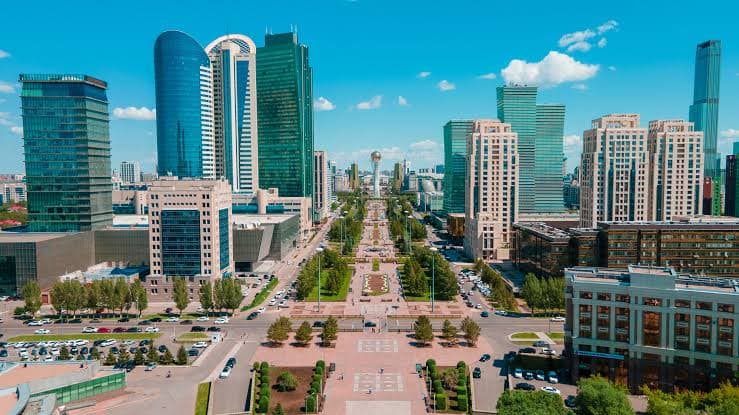
On an ordinary weekday morning in Kazakhstan, a family may leave an apartment built only a few years ago, take their child to a recently opened school and drive to work in a car assembled domestically. One parent may work for a large company, while the other runs a small business selling goods through digital marketplaces, receiving cashless payments and dealing with government agencies online.
None of these experiences is remarkable on its own. Taken together, however, they reveal how much Kazakhstan has changed over the past several years. The country entered this period in 2019 with abundant natural resources, a relatively developed financial system, and decades of experience attracting international investment. Yet it also faced a harder question. Could Kazakhstan turn these advantages into a broader improvement in living standards while preparing its economy for a future less dependent on oil and other commodities?
The record of the past seven years suggests this transition is underway. Kazakhstan has had to navigate a global pandemic, disrupted supply chains, and an increasingly fragmented geopolitical environment. Nevertheless, the country that emerged from these challenges is larger economically, more entrepreneurial, and better connected than it was in 2019.
Growth Measured Through People
Kazakhstan's GDP per capita rose by more than 50% over seven years. It reflects an economy that has continued to expand despite successive external shocks and a population that has grown beyond 20 million. It also places Kazakhstan in a distinct position within Central Asia. World Bank data for 2025 put the country's GDP per capita at approximately $14,700, compared with around $4,000 in Uzbekistan and $3,100 in the Kyrgyz Republic.
Income per capita alone, however, does not explain how an economy functions. A more revealing change appears in the growing role of private enterprise. Some 4.5 million people were employed by small and medium-sized businesses in Kazakhstan, up 31.6% over seven years. The number of registered SME entities has risen even faster, by 47.5%, to 2.3 million by the end of 2025. In practical terms, more than one in five Kazakhstanis is now connected to this sector.
This matters because Kazakhstan has long faced a challenge common to many resource-rich economies: the state and several large companies have traditionally held dominant positions. The expansion of small business does not mean that this structural issue has disappeared. It does mean that a broader entrepreneurial economy is taking shape alongside the country's established industries.
Under President Kassym-Jomart Tokayev, this shift has become part of a wider effort to make economic opportunity less concentrated. His political message of a “Fair Kazakhstan” has frequently been interpreted through institutional and social reforms. Its economic meaning is equally important: growth is sustainable only when more people can participate. New businesses, industrial projects, construction and public services have all contributed to a labour market that must absorb a young and increasingly urban population.
When Growth Becomes Visible
Economic statistics are most persuasive when they acquire a physical form. In Kazakhstan, much of the transformation of recent years is visible in homes, schools, clinics and factories. Between 2019 and 2025, the country commissioned 118.3 million square metres of housing. The scale reflects both rising demand and Kazakhstan's demographic reality. Its population is growing, cities are attracting new residents, and young families need housing and the infrastructure to support it.
That is why building 761 schools and 345 kindergartens is not a simple set of figures. New schools respond to overcrowded classrooms, migration into major urban centers, and the arrival of a new generation of Kazakhstanis. Their significance lies not in the buildings themselves, but in whether rapid economic and demographic growth can be translated into better conditions for children. Healthcare has expanded similarly. In the three years from 2023 to 2025 alone, the country built 813 healthcare facilities, 655 of which are primary healthcare facilities in rural areas. During the same period, life expectancy increased by 2.79 years, reaching 75.97 years.
No single policy or construction programme can fully explain such a change. Life expectancy is influenced by income, lifestyles, medical access, environmental conditions and demographic factors. Yet the direction is significant. One of the clearest tests of national development is not simply whether an economy produces more, but whether people live longer and healthier lives. Tokayev's presidency has coincided with this change in emphasis. His administration has had to respond to a society that is younger, more connected, and more demanding than it was a decade ago. Stability is still valued, but it is increasingly judged by what it delivers.
From Importing Goods to Making Them
Kazakhstan's economic model cannot be transformed through social spending alone. The country also needs to produce more of what it consumes and create employment outside extractive industries.
Automotive manufacturing offers a tangible example. Kazakhstan produced approximately 800,000 vehicles over the past seven years. A car assembled domestically represents more than a consumer product. It supports suppliers, logistics companies, engineers, technicians, and skilled factory workers. It also signals the gradual formation of industrial capabilities that were once largely absent.
The same process is visible across a wider range of industries. According to the Kazakh Government, 860 projects were implemented in special economic zones and industrial zones alone by the end of 2025, creating more than 57,200 jobs. And some 200 new projects are expected to be implemented there by 2030, creating jobs and boosting manufacturing growth. Kazakhstan also plans to launch 140 manufacturing projects in 2025-2029. Each new plant expands the productive base of an economy that has historically relied heavily on exporting raw materials.
Kazakhstan is not abandoning its natural advantages. Oil, uranium, metals and agriculture will remain essential to its prosperity. The more realistic objective is to build additional economic layers around them: processing raw materials domestically, manufacturing more finished goods and connecting local producers to international supply chains.
This is also where Kazakhstan's geography is beginning to acquire a different meaning. For years, being the world's largest landlocked country was viewed primarily as a constraint. Today, as trade routes across Eurasia are being reconsidered, Kazakhstan increasingly presents itself as a junction between China, Europe, Russia, the Caucasus and the wider Central Asian region.
The Region's Largest Economic Platform
Central Asia as a whole has entered a period of renewal. Uzbekistan has opened its economy and developed rapidly. The Kyrgyz Republic and Tajikistan have also recorded strong growth from lower starting points. Their progress benefits Kazakhstan: developing neighbours mean larger markets, stronger trade links and a more influential region. But Central Asian economies do not yet possess the same level of financial and institutional capacity.
Kazakhstan's nominal economy reached approximately $306 billion in 2025, compared with about $147 billion for Uzbekistan and $22.6 billion for the Kyrgyz Republic, according to World Bank data. Its higher income per capita, accumulated investment stock, more developed financial sector, and international business infrastructure give it a different role in the region.
The scale of foreign investment illustrates this advantage. Gross inflows of foreign direct investment (FDI) reached $20.5 billion in 2025 alone, up 14.4% from 2024. The Kazakh economy continues to attract investment. These figures alone show Kazakhstan's continued ability to attract international capital amid exceptional global uncertainty.
Investors are drawn partly by resources, but not only by them. Kazakhstan offers a sizeable economy, access to surrounding markets, established relations with both East and West, and financial institutions designed to serve international business. This combination is difficult to replicate quickly.
Today, Kazakhstan serves as the region's principal economic platform: a place where capital is raised, goods are produced, and companies can enter the wider Central Asian market.
Moving in an Age of Disruption
Seven years is a relatively short period in a nation's development, yet an unusually eventful one. Since taking office in 2019, President Tokayev has governed through crises that would have tested far more established political and economic systems. His leadership has been defined less by a single landmark project than by an attempt to recalibrate the relationship between the state, business and society. This has included greater attention to social infrastructure, support for entrepreneurship, industrial development and efforts to make public institutions more responsive.
At the same time, Kazakhstan has preserved the pragmatic, multi-vector foreign policy that remains vital to a country situated between major powers. Maintaining working relations with China, Russia, the European Union, the United States and the wider Islamic and Turkic worlds has allowed it to attract capital and protect its room for manoeuvre at a time of geopolitical division.
There are still significant challenges. Inflation continues to affect household incomes. Differences between major cities and rural communities remain visible. Infrastructure must keep pace with demographic growth, while state participation in the economy is still considerable. New industrial facilities must become genuinely competitive, not merely satisfy production targets.
Acknowledging these constraints does not diminish the changes of the past seven years. It makes them more credible. The ordinary family beginning its day in a new apartment, sending a child to a new school and earning its living in an increasingly diverse economy may never think of itself as evidence of national transformation. Yet development is ultimately measured through such ordinary experiences.
Kazakhstan has not completed its transition. But under President Tokayev, it has moved from preserving past achievements to building the economic and social foundations of its next stage.